
Last Updated on October 14, 2026 by admin
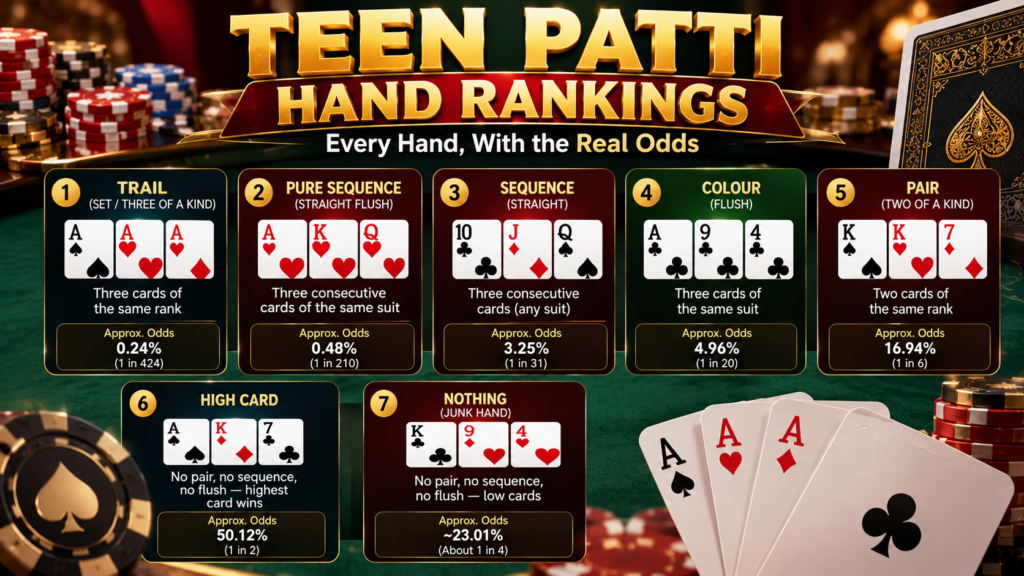
Quick answer: Teen Patti has six hands. From highest to lowest: trail (three of a kind), pure sequence (three cards in a row, same suit), sequence (three in a row, mixed suits), colour (three of the same suit), pair, and high card. The best possible hand is a trail of aces (A-A-A).
Teen Patti, India’s favourite three-card game, is quick to learn. But most players know the ranking list without knowing what sits behind it: how rare each hand is, how ties are broken, and how strong a hand really is once other players are in the game. This guide covers all of it, with odds calculated from every possible deal.
Teen Patti hand rankings at a glance
| Rank | Hand | What it is | Example |
|---|---|---|---|
| 1 | Trail (also called set or trio) | Three cards of the same rank | 9♠ 9♥ 9♦ |
| 2 | Pure sequence (pure run) | Three consecutive cards of the same suit | 4♣ 5♣ 6♣ |
| 3 | Sequence (run) | Three consecutive cards, not all the same suit | 4♣ 5♦ 6♠ |
| 4 | Colour (flush) | Three cards of the same suit, not in sequence | 2♥ 7♥ J♥ |
| 5 | Pair | Two cards of the same rank | Q♠ Q♦ 8♣ |
| 6 | High card | None of the above | A♦ 9♠ 4♣ |
Teen Patti is played with one standard 52-card deck, no jokers, and each player gets three cards. The ace counts as the highest card, but it can also be used low in the sequence A-2-3.
The real odds of every Teen Patti hand
There are 22,100 different three-card hands that can be dealt from a 52-card deck. Here is how many of them make each hand, and how often you can expect to be dealt one:
| Hand | Number of ways | Chance | Roughly 1 in |
|---|---|---|---|
| Trail | 52 | 0.24% | 425 hands |
| Pure sequence | 48 | 0.22% | 460 hands |
| Sequence | 720 | 3.26% | 31 hands |
| Colour | 1,096 | 4.96% | 20 hands |
| Pair | 3,744 | 16.94% | 6 hands |
| High card | 16,440 | 74.39% | 1.3 hands |
The most useful number in that table is the last one. Three out of every four hands are just a high card. Being dealt a pair or better happens only about one hand in four, which is why even a small pair is a strong hand in Teen Patti.
Where these numbers come from
You can check each figure yourself:
- Trail: 13 ranks, and 4 ways to choose three of the four suits: 13 × 4 = 52.
- Pure sequence: 12 possible runs (A-2-3 up to Q-K-A) in each of 4 suits: 12 × 4 = 48.
- Sequence: 12 runs, each with 4 × 4 × 4 = 64 suit combinations, minus the 4 that are pure: 12 × 60 = 720.
- Colour: 286 ways to pick three cards from one suit, minus the 12 runs, in 4 suits: 274 × 4 = 1,096.
- Pair: 13 ranks for the pair × 6 suit combinations × 48 choices for the third card = 3,744.
- High card: everything else: 22,100 − 5,660 = 16,440.
Why is a pure sequence ranked below a trail when it’s rarer?
Look closely at the odds table and you’ll spot something odd. A pure sequence (48 ways) is slightly rarer than a trail (52 ways), yet the trail ranks higher.
The reason is tradition, not maths. Teen Patti grew out of older three-card games, and the trail has always been the top hand. Casino Three Card Poker, a Western game, follows the maths instead and ranks the straight flush above three of a kind. In Teen Patti, the trail stays on top.
In practice, the difference hardly matters: both hands turn up about once in every 425–460 deals.
Why a sequence beats a colour (the opposite of poker)
Players who know poker often expect a colour (flush) to beat a sequence (straight), because that’s the order in five-card poker. In Teen Patti it’s the other way round, and this time the ranking does follow the maths.
With only three cards, a sequence is harder to make than a colour: there are 720 ways to make a mixed-suit sequence, but 1,096 ways to make a colour. The rarer hand ranks higher. With five cards, the balance flips, which is why poker ranks the flush higher. Our poker vs rummy guide explains more differences between card games that look alike.
How ties are broken within each hand
When two players hold the same type of hand, these rules decide the winner.
Trail
The higher rank wins. A-A-A is the best trail and 2-2-2 the lowest.
Pure sequence and sequence
The higher run wins. Under the most common rules, the order is:
- A-K-Q (highest)
- A-2-3 (second highest)
- K-Q-J
- Q-J-10, and so on down to
- 4-3-2 (lowest)
A-2-3 ranking second is the rule that surprises most new players. Some tables rank A-2-3 as the lowest run instead, so check the rules before you play.
Runs can’t wrap around: K-A-2 is not a sequence.
Colour
Compare the highest card first. If those match, compare the second card, then the third. For example, A♠ 9♠ 3♠ beats K♥ Q♥ 10♥, because the ace outranks the king. (Note that K♥ Q♥ J♥ would not be a colour at all: it’s a pure sequence, which beats every colour.)
Pair
The higher pair wins. If both players have the same pair, the higher third card decides it. Q-Q-8 beats Q-Q-5.
High card
Compare the highest cards, then the second, then the third. A-9-4 beats A-8-7.
Identical hands
If two hands are equal in every rank, for example both players hold A-K-J high card in different suits, the hand is usually a tie and the pot is split. Suits don’t normally break ties in Teen Patti, but some tables have their own rules, so check before you play.
How strong is your hand, really?
Knowing the ranking is one thing. Knowing how often your hand actually wins is another. We compared sample hands against every possible hand a single opponent could hold, and simulated 150,000 deals against three opponents:
| Your hand | Beats 1 opponent | Beats all of 3 opponents |
|---|---|---|
| 5-3-2 mixed suits (the lowest hand) | 0% | 0% |
| Q-10-4 mixed suits | 38% | 5% |
| A-K-J mixed suits | 74% | 41% |
| Pair of 2s | 74% | 41% |
| Pair of 8s | 83% | 56% |
| Pair of aces | 91% | 76% |
| Colour, 7-high | 91% | 76% |
| Colour, ace-high | 96% | 88% |
| Sequence 2-3-4 | 96% | 89% |
| Sequence A-K-Q | 99% | 98% |
| Pure sequence 2-3-4 | 99.5% | 99% |
| Trail of 2s | 99.7% | 99% |
“Beats” means wins outright; ties are rare and not counted as wins.
Three things stand out:
- A strong high card is worth more than it looks. A-K-J with no pair wins about as often as a pair of 2s. Against one opponent, both win roughly three times in four.
- More opponents change everything. A pair of 8s wins 83% of the time against one player, but only about 56% against three. The more players stay in, the stronger your hand needs to be.
- Anything from a colour upward is very strong. Even the lowest colour beats more than nine in ten single opponents.
Teen Patti hand rankings in Muflis
Muflis, also called lowball, is a popular Teen Patti variant where the rankings are turned upside down: the lowest hand wins.
- The best hand in Muflis is usually 5-3-2 in mixed suits, the lowest possible high card. (4-3-2 doesn’t count, because it’s a sequence.)
- Pairs, colours, sequences and trails all become bad hands, with a trail of aces the worst of all.
If you switch between regular Teen Patti and Muflis, take a second look at your cards before you act. A hand that would win one game loses the other.
Other variants, such as games with wild cards, change the odds in this guide, because wild cards make strong hands much more common. The rankings above apply to standard Teen Patti.
Where hand rankings matter during a game
Hand rankings come into play in two moments:
- Show: when only two players are left, one can ask for a show. Both reveal their cards, and the higher hand wins.
- Sideshow: a player who has seen their cards can ask the previous player, if they have also seen their cards, to compare hands privately. The weaker hand folds. The other player can accept or refuse.
Because most hands are high cards, many shows are decided by the highest card, so it pays to know the high-card rules as well as the big hands.
Common mistakes with Teen Patti rankings
- Thinking a colour beats a sequence. It’s the other way round in Teen Patti.
- Forgetting that A-2-3 is a high run. Under the usual rules, it’s the second-best sequence.
- Counting K-A-2 as a sequence. Runs don’t wrap around.
- Overvaluing a small pair against many players. A pair of 2s wins about 74% of the time against one opponent, but only about 41% against three.
- Playing Muflis with regular-ranking instincts. In Muflis, a trail is a losing hand.
Frequently asked questions
What is the highest hand in Teen Patti?
A trail, three cards of the same rank. The best trail is three aces (A-A-A).
Which is bigger in Teen Patti, a sequence or a colour?
A sequence. With three cards, a sequence is rarer than a colour (720 combinations against 1,096), so it ranks higher. This is the opposite of five-card poker.
Is A-2-3 higher than K-Q-J in Teen Patti?
Under the most common rules, yes. A-K-Q is the highest sequence, A-2-3 is second, and K-Q-J is third. Some tables rank A-2-3 lowest, so check the rules.
What is a pure sequence in Teen Patti?
Three consecutive cards of the same suit, such as 7♥ 8♥ 9♥. It’s the second-best hand, after a trail.
What happens if two players have the same hand?
Usually the hand is a tie and the pot is split. Suits don’t normally decide ties in Teen Patti.
What are the chances of getting a trail in Teen Patti?
About 0.24%, or roughly once every 425 hands.
What is the lowest hand in Teen Patti?
5-3-2 in mixed suits. It’s the lowest high card that isn’t a sequence, which also makes it the best hand in Muflis.
Can I play Teen Patti for real money on DuraGaming?
No. DuraGaming is a social casino. You play Teen Patti and our other games with the virtual currency Dura, which can’t be converted into real money.
Try it yourself
The fastest way to learn the rankings is to play a few hands and check each result against the table above. You can try several Teen Patti variants, including Muflis, among our casino games, all played with virtual Dura. Keep it fun, set a time limit, and visit our responsible gaming page for tips.
Related guides
Odds calculated for standard Teen Patti with one 52-card deck and no wild cards. Hand-strength figures compare every possible opponent hand; three-opponent figures come from a 150,000-deal simulation.