
Last Updated on October 7, 2026 by admin
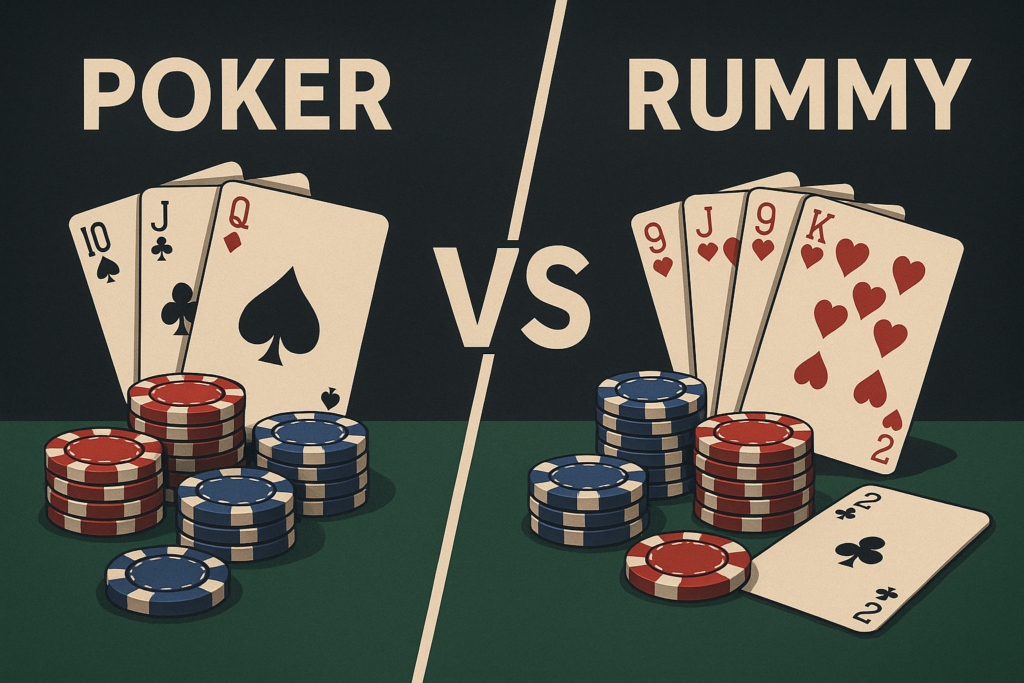
Quick answer: No, poker and rummy are not the same. In rummy, you draw and discard cards to arrange your whole hand into sets and sequences. In poker, you bet on who holds the best five-card hand, and you can win by making everyone else fold. Both use standard playing cards, which is why people mix them up, but the goal, the rules and the skills are completely different.
This guide compares the two side by side, shows an example hand from each game, and explains which one suits you better.
Poker vs rummy at a glance
The table below compares Indian 13-card rummy, the most popular rummy in India, with Texas Hold’em, the most popular form of poker.
| Rummy (13-card Indian rummy) | Poker (Texas Hold’em) | |
|---|---|---|
| Goal | Arrange all your cards into valid sequences and sets | Have the best five-card hand, or make others fold |
| Players | 2–6 | 2–10 |
| Cards used | Usually 2 decks plus jokers | 1 deck, no jokers |
| Cards you get | 13, all your own | 2 private cards plus 5 shared cards |
| Do you draw cards? | Yes, every turn you draw one and discard one | No, you play with what you’re dealt |
| Betting during the hand | None in the game itself | Up to four betting rounds |
| Jokers | Yes, as wild cards | No |
| How a hand ends | One player declares a complete, valid hand | Showdown of best hands, or all others fold |
| Main skill | Planning and card memory | Reading opponents and betting decisions |
7 key differences between poker and rummy
1. The goal
In rummy, you’re racing to organise your hand. In poker, you’re competing for the pot. A rummy player never needs to beat another player’s hand directly; a poker player always does, unless everyone else folds.
2. The cards
Indian rummy uses two decks with printed jokers, plus a randomly chosen “wild joker” rank. Poker uses one 52-card deck with no wild cards.
3. Drawing and discarding
Every rummy turn, you pick a card from the closed or open pile and throw one away. Your hand keeps changing. In Texas Hold’em, your two private cards never change; only the shared cards on the table are revealed over time.
4. Betting
Betting is the heart of poker: check, bet, raise or fold over up to four rounds. Rummy has no betting inside the game. Points are counted only when someone declares.
5. Bluffing
In poker, you can win with a weak hand by betting as if it’s strong. Rummy has no bluffing in that sense. The closest thing is hiding which cards you need by choosing your discards carefully.
6. How a winner is decided
In rummy, the first player to declare a valid hand wins, and everyone else scores points for their unmatched cards (lower is better). In poker, the best hand at showdown wins, or the last player still in the hand wins.
7. Where the skill lies
Rummy rewards planning and memory: tracking discards and knowing which cards are still available. Poker rewards probability, patience and reading other players’ behaviour.
How rummy works: an example hand
In 13-card rummy, a valid hand needs at least two sequences, and at least one must be a pure sequence (no joker). The rest can be sets or sequences.
| Group | Cards | Type |
|---|---|---|
| 1 | 5♥ 6♥ 7♥ | Pure sequence (no joker) |
| 2 | 9♠ 10♠ Joker Q♠ | Sequence with a joker in place of J♠ |
| 3 | K♣ K♦ K♥ | Set (same rank, different suits) |
| 4 | 4♣ 4♦ 4♠ | Set |
That’s 13 cards, all grouped, so this player can declare and win. Learn more about jokers in our guide on how to use the joker in rummy, or see the maths behind your draws in probability in rummy.
How poker works: an example hand
In Texas Hold’em, you make the best five-card hand from your two private cards and five shared cards.
| Your cards | Shared cards on the table | Your best hand |
|---|---|---|
| A♠ K♠ | K♦ 9♠ 4♠ 2♣ 7♠ | Ace-high flush: A♠ K♠ 9♠ 7♠ 4♠ |
A flush beats a straight, three of a kind and two pairs, so this hand is very strong. But if another player had bet heavily all the way, you would still need to decide whether they could hold something better. That betting decision is what makes poker a different kind of game from rummy. Our poker guide covers the full hand rankings.
Is rummy or poker more skill-based?
Both involve skill and luck. The deal is random in both games, but over many hands, better decisions win out.
In India, courts have repeatedly described both games as games of skill. In 2024, for example, the Allahabad High Court held that poker and rummy are games of skill and not gambling.
That distinction no longer matters for online money games. India’s Promotion and Regulation of Online Gaming Act, 2025 came into force on 1 May 2026. It bans online games played for money, whether based on skill or chance, including poker and rummy. Free and social games, where nothing of real value is staked, are not banned. Petitions challenging the Act have been before the Supreme Court, so check for updates.
Which should you play: poker or rummy?
| Choose rummy if you… | Choose poker if you… |
|---|---|
| Like planning and arranging cards | Like reading people and taking calculated risks |
| Want a game with no betting decisions | Enjoy betting strategy and bluffing |
| Prefer longer turns with steady progress | Prefer fast hands with big swings |
| Are new to card games | Already know basic hand rankings |
Most beginners find rummy easier to start, because there are no betting decisions. Poker’s rules take minutes to learn, but its betting strategy takes much longer to master.
Frequently asked questions
Are rummy and poker the same game?
No. Rummy is about forming sets and sequences by drawing and discarding. Poker is about betting on the best five-card hand.
What is the main difference between poker and rummy?
Betting. Poker is built around rounds of betting and bluffing. Rummy has no betting during the hand; you win by declaring a complete, valid hand first.
Is rummy easier than poker?
For most beginners, yes. Rummy has more rules to learn at first, but no betting decisions. Poker is quick to learn but hard to play well.
Do poker and rummy use the same cards?
Both use standard playing cards, but Indian rummy usually uses two decks plus jokers, while poker uses one deck with no jokers.
Is playing poker or rummy online for money legal in India?
No. Since 1 May 2026, the Promotion and Regulation of Online Gaming Act, 2025 bans online poker and rummy played for money. Free and social versions are allowed.
Can I win real money on DuraGaming?
No. DuraGaming is a social casino. You play with the virtual currency Dura, which can’t be converted into real money.
Related guides
Legal status checked October 2026. Laws change, so check current rules where you live.