
Last Updated on July 7, 2026 by admin
Teen Patti — literally “three cards” in Hindi — is India’s favorite card game: a fast, three-card betting game for 3 to 6 players where nerve matters as much as the cards. If you’ve watched a Diwali game and felt lost when someone said chaal, blind, or sideshow, this guide fixes that in about ten minutes.
Below you’ll find the complete Teen Patti rules, the full hand rankings chart with the exact odds of each hand, how blind and seen betting actually works, the sideshow and show rules that decide every pot, and the popular variations like Muflis and AK47.
Teen Patti at a Glance
| Players | 3–6 is ideal (works with up to 10) |
| Cards | Standard 52-card deck, no jokers |
| Deal | 3 cards face-down to each player |
| Ranking | Aces high, 2s low |
| Goal | Hold the best 3-card hand at showdown — or bet everyone else out of the pot |
Teen Patti descends directly from the 18th-century British game Three Card Brag — the games are nearly identical, and Brag itself is one of poker’s ancestors, which is why Teen Patti feels like poker compressed into its purest form: three cards, one betting phase, maximum bluffing. History buffs can trace the full lineage on the Brag Wikipedia page or in Pagat’s detailed Three Card Brag rules.
Teen Patti Hand Rankings Chart (Highest to Lowest)
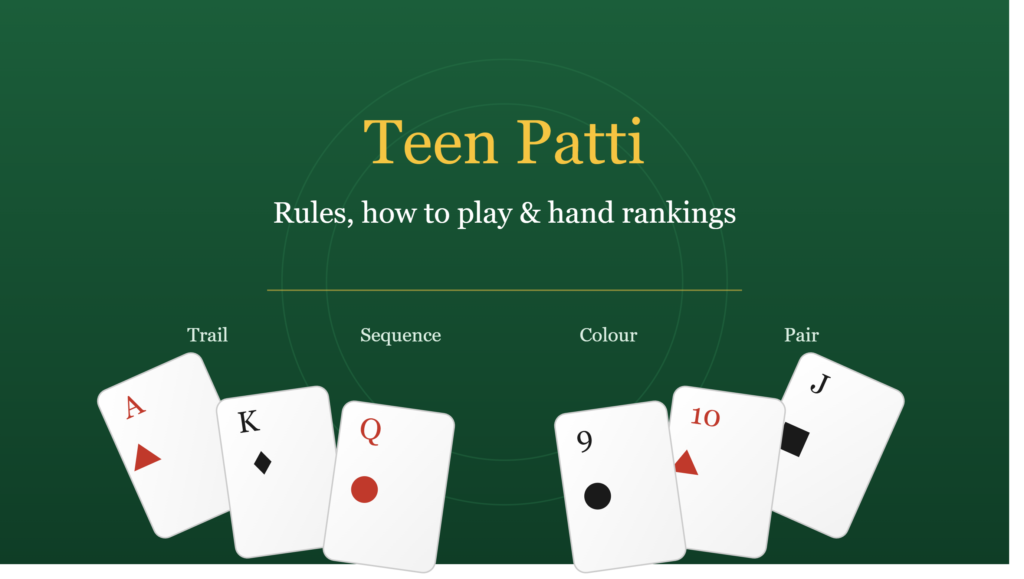
This chart is the heart of the game — memorize it before anything else, because every betting decision flows from it. There are exactly 22,100 possible three-card hands, and every one falls into six categories:
| Rank | Hand | What It Is | Example | Odds of Being Dealt |
|---|---|---|---|---|
| 1 | Trail / Trio / Set | Three cards of the same rank | A♠ A♥ A♦ | 0.24% (1 in 425) |
| 2 | Pure Sequence (Straight Flush) | Three consecutive cards, same suit | 4♥ 5♥ 6♥ | 0.22% (1 in 460) |
| 3 | Sequence / Run (Straight) | Three consecutive cards, mixed suits | 4♥ 5♠ 6♦ | 3.26% |
| 4 | Color (Flush) | Three same-suit cards, not consecutive | 2♣ 7♣ K♣ | 4.96% |
| 5 | Pair | Two cards of the same rank | 9♦ 9♣ Q♠ | 16.94% |
| 6 | High Card | None of the above | A♠ 7♦ 4♣ | 74.39% |
Two things in this chart shape all Teen Patti strategy. First, three out of four hands you’re dealt will be nothing but a high card — which is why bluffing and blind play are built into the game’s DNA, not bolted on. Second, notice the quirk at the top: a pure sequence is actually rarer than a trail (0.22% vs 0.24%), yet the trail ranks higher. That’s tradition, inherited straight from Brag, and every table plays it that way.
How Ties Break Within Each Hand
Trail: higher rank wins — A-A-A beats K-K-K beats Q-Q-Q, down to 2-2-2. Even the lowly 2-2-2 beats every non-trail hand in the game.
Pure sequence and sequence: in traditional Teen Patti, A-2-3 is the highest run, followed by A-K-Q, then K-Q-J, and so on down to 4-3-2 (the lowest). Note this well — poker players always get it backwards. Some tables and most online apps rank A-K-Q above A-2-3 instead, so confirm before the first deal. K-A-2 and 2-A-K are never valid runs.
Color: compare highest cards; if equal, the second, then the third. A-K-J is the best possible color, 5-3-2 the worst.
Pair: higher pair wins; equal pairs are decided by the third card (the kicker). A-A-K is the top pair hand, 2-2-3 the bottom.
High card: compare the highest card, then second, then third. A-K-J of mixed suits is the best high-card hand.
If two hands are exactly equal in value at a show, the player who paid for the show loses — the demander needs to beat, not tie.
Setup: Boot, Deal, and the Pot
- Agree the boot amount — the minimum stake every player puts into the pot before the deal. The boot seeds the pot and sets the scale for all betting that follows.
- The dealer shuffles and deals three cards face-down to each player, one at a time, moving clockwise.
- Play starts with the player to the dealer’s left and moves clockwise.
That’s the entire setup — no community cards, no draws, no multiple streets. Everything from here is betting.
How to Play Teen Patti: Blind, Seen, and Chaal
On your turn you have three basic options: bet (called chaal), fold (called pack), or — in the right circumstances — request a sideshow or show. What makes Teen Patti unique is that your betting cost depends on whether you’ve looked at your cards.
Playing Blind vs Playing Seen
- A blind player hasn’t looked at their cards. Blind players bet at the cheapest rate and carry an intimidation premium — nobody knows if they’re brave or just reckless, including them.
- A seen player (playing chaal) has looked. Information costs money: seen players must bet at double the blind rate.
You can look at your cards at any point in the hand — the moment you do, you become a seen player for the rest of that hand. Blind players who fold before ever looking never learn what they threw away, which is either the best or worst part of the game, depending on the night.
How Much to Bet: The Current Stake
All bets are measured against the current stake:
| Your Status | You Must Bet |
|---|---|
| Blind | 1x the current stake (or 2x to raise) |
| Seen | 2x the current stake (or 4x to raise) |
The current stake updates as follows: when a blind player bets, the amount they put in becomes the new current stake. When a seen player bets, half their bet becomes the new current stake (because they were paying the doubled seen rate).
Worked example: boot is ₹10, so the opening stake is 10. Player A (blind) bets 10 — stake stays 10. Player B (seen) must bet 20 or raise to 40; they bet 20 — stake stays 10. Player C (blind) can still call for just 10. That asymmetry — blind players riding cheaply while seen players pay double — is the engine of the whole game.
Unlike poker, there’s no checking and betting continues around the table indefinitely until players fold or a show ends it. Pots grow faster than newcomers expect; set limits before the boot goes in.
The Sideshow (Compromise)
When a seen player has just bet, the next seen player may pay the chaal amount and request a sideshow — a private comparison of the two hands. The asked player can accept or decline (most tables allow declining twice at most; house rules vary):
- Accepted: the two players compare cards privately. The lower hand must fold immediately. If the hands are equal, the requester folds.
- Declined: betting simply continues.
Blind players can neither request nor be asked for a sideshow — you can’t compare cards nobody has seen. The sideshow is Teen Patti’s pressure-release valve, and knowing when to accept one is a genuine skill: declining tells the table something, too.
The Show (Showdown)
A show can happen only when two players remain:
- A blind player may ask for a show by paying 1x the current stake — and may do so without ever looking at their own cards, which is peak Teen Patti theatre.
- If both players are seen, either may pay 2x the current stake for a show.
- A seen player cannot demand a show from a blind player — the blind player’s privilege holds to the end.
Cards are revealed, the higher-ranked hand takes the entire pot, and the deal passes on. If everyone else folds before a show, the last player standing wins the pot without showing anything — exactly like poker, the best hand and the winning hand are not always the same thing.
Popular Teen Patti Variations
Once your table knows the classic game, these are the variations you’ll meet most often:
- Muflis (Lowball): rankings are reversed — the worst classic hand wins, so 2-3-5 of mixed suits becomes a monster and A-A-A becomes the worst hand in the game.
- AK47: all Aces, Kings, 4s, and 7s are wild (jokers). Hand values inflate wildly; pairs become nearly worthless.
- Joker: each player’s deal is accompanied by randomly designated joker cards (often one card rank pulled from the deck) that act as wilds.
- 999: closest to a hand of 9-9-9 wins; face cards count as zero.
- Best of Four: four cards are dealt; each player makes their best three-card hand from them.
- Royal: if you’re dealt A-K-Q of any kind, you win bonuses or the pot outright, per table agreement.
House rules dominate variation play — settle wild-card behavior and sequence rankings before dealing, or settle arguments after.
Teen Patti vs Poker: The Key Differences
Poker players pick up Teen Patti in one evening, but four differences cause expensive confusion:
- A-2-3 outranks A-K-Q in traditional sequences — the reverse of poker instinct.
- A flush (“color”) ranks below a straight (“sequence”) — again the reverse of poker, because with three cards, flushes are more common than straights.
- There’s no checking — every turn costs money or your cards.
- Blind play is a core mechanic, not a novelty — the cheap-blind/expensive-seen structure has no poker equivalent and changes the bluffing math completely.
The psychological game, though, transfers directly: reading betting patterns, managing your own tells, and choosing when aggression is credible are the same muscles. Our guides on Texas Hold’em strategy and how to improve your poker face cover those fundamentals — both apply seat-for-seat at a Teen Patti table, where you’re being read by people who’ve known your tells since childhood.
5 Beginner Tips for Teen Patti
- Play blind more than feels comfortable early in a hand. It’s mathematically cheap, it builds an unreadable image, and it pressures seen players who are paying double to stay with mediocre cards.
- Fold most high-card hands once the pot gets serious. You’ll hold nothing but a high card 74% of the time — so will everyone else, but paying seen rates to find out is how stacks vanish.
- Respect the sideshow. If a tight player accepts your sideshow instantly, believe them.
- Don’t bluff the whole table. Bluffs work against one or two opponents; against five, someone always has a pair.
- Set your boot and your limit before the first deal. Teen Patti’s endless betting rounds inflate pots deceptively fast. Decide what the evening costs before it starts, treat it as entertainment spend, and step away when the limit’s reached — our responsible gambling page has practical tools for exactly this. The same goes for keeping games friendly: the card game etiquette basics apply double when money’s on the table.
Teen Patti FAQ
What is the highest hand in Teen Patti?
A trail (three of a kind), and specifically A-A-A — three aces is the best possible hand. It beats a pure sequence even though a pure sequence is statistically rarer.
Is A-2-3 the highest sequence in Teen Patti?
In the traditional game, yes — A-2-3 is the highest run, followed by A-K-Q, then K-Q-J down to 4-3-2. Some tables and many online apps rank A-K-Q first instead, so agree on the rule before playing.
Does a trail beat a pure sequence?
Yes. Trail > pure sequence > sequence > color > pair > high card, always — even though the pure sequence is actually the rarer hand.
How many players can play Teen Patti?
Anywhere from 3 to 6 players is ideal with a single 52-card deck; the game technically supports up to 10, but pots and wait times balloon beyond 6 or 7.
What is the boot amount in Teen Patti?
The boot is the compulsory minimum stake every player contributes to the pot before cards are dealt. It seeds the pot and defines the opening stake for the betting.
What is the difference between blind and chaal?
A blind player bets without looking at their cards and pays the base stake. A player who has seen their cards plays chaal and must bet double the current stake. Blind players can also demand a show against a final opponent for just 1x the stake — a privilege seen players don’t have.
What is a sideshow in Teen Patti?
A private card comparison between two consecutive seen players. The requester pays the chaal amount; if the other player accepts, whoever holds the lower hand folds immediately. Blind players can’t participate in sideshows.
Is Teen Patti the same as 3 Patti?
Yes — “3 Patti” is just the numeral spelling of the same game. It’s also known as Flush or Flash in parts of India, and it’s essentially identical to British Three Card Brag, as documented on Wikipedia’s Teen Patti page.
Final Thoughts
Teen Patti’s genius is its compression: six hand ranks, one betting loop, and the blind/seen asymmetry generate more psychology per minute than almost any card game ever designed. Learn the rankings chart cold — especially the two rules that trip up poker players (A-2-3 on top, sequence beats color) — agree on the variations before the boot goes in, and keep the stakes at entertainment level.
Then deal three cards and find out what kind of player you are when you haven’t even looked at them yet.
